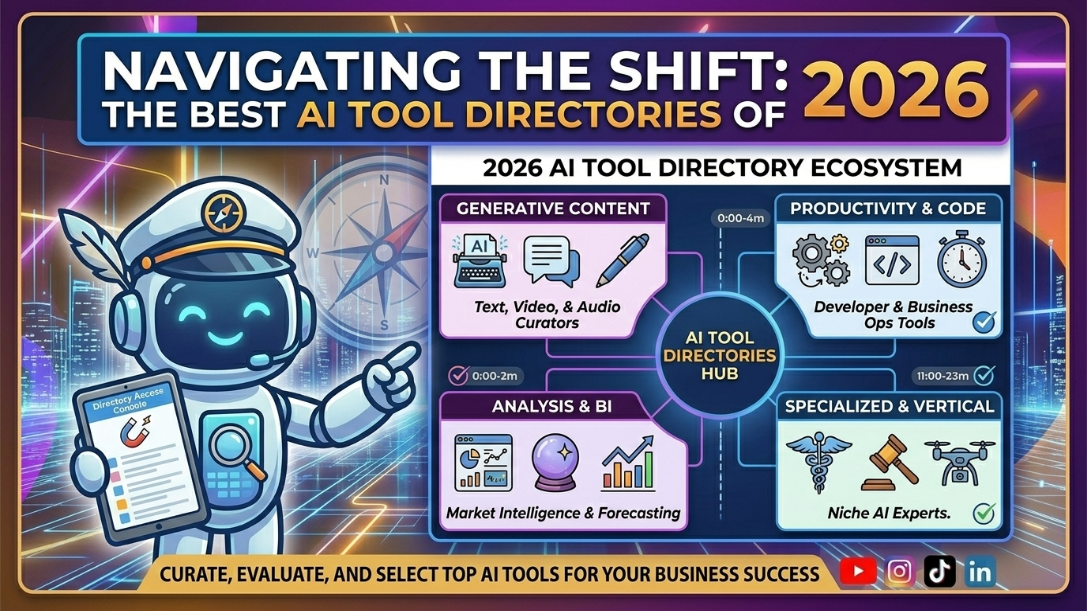
Navigating the Shift: The Best AI Tool Directories of 2026
Finding the right software has become a massive challenge. With thousands of niche platforms launching constantly, standard search engines often leave you wading through sponsored links and repetitive listicles.
To solve this, AI tool directories have evolved from simple bookmark lists into sophisticated search engines.
The top directories in the ecosystem excel at helping you discover the ideal software for your workflow.
The Top AI Directories Ranked by Use Case
Different directories serve different workflows. Rather than trying to cover every tool poorly, the best platforms have carved out specific curation strategies.
| Directory | Best For | Standout Feature |
| There’s An AI For That (TAAF) | Task-Based Search | Maps tools to highly specific human actions and jobs. |
| FutureTools | Curation & Simplicity | Hand-picked recommendations that filter out spam. |
| Toolify | Trending & Traffic Metrics | Tracks monthly traffic data to show what people actually use. |
| AIxploria | Comprehensive Exploration | Large, human-verified database covering massive categories. |
| Futurepedia | Professionals & Marketers | Advanced multi-variable filtering (pricing, features, enterprise readiness). |
Deep Dive: What Makes These Directories the Best?
1. There’s An AI For That (TAAFT) — Best for Problem-Solving
Most directories ask you to browse categories like "Copywriting" or "Video." TAAFT flips this concept entirely by focusing on the exact task you want to achieve.
How it works: You type in a specific problem—like "automatically generate a transcript and turn it into a newsletter"—and it maps the request to an exact sequence of tools.
Why it’s great: It completely eliminates the friction of needing to know industry jargon or tool names before you start searching.
2. FutureTools — Best for Curation (Curated by Matt Wolfe)
If you suffer from choice paralysis, FutureTools is the antidote.
How it works: Instead of listing every single wrapper app that launches, the directory features a tightly controlled list of stable, highly functional tools.
Why it’s great: The filtering system is incredibly clean. With a couple of clicks, you can instantly isolate "Free" or "Open Source" tools without having to dig through hidden paywalls.
3. Toolify — Best for Spotting Real Trends
It is easy for software companies to buy fake reviews, but it is much harder to fake massive traffic numbers. Toolify tracks the actual popularity and web traffic of AI tools.
How it works: It ranks software based on monthly growth, total visits, and geographic trends.
Why it’s great: It allows creators, investors, and early adopters to spot viral software before it hits mainstream tech blogs, giving a clear picture of what the community genuinely relies on.
4. AIxploria — Best for Massive Variety
With a database scaling past 5,000 manually verified tools, AIxploria is built for deep-dive research.
How it works: It acts as a massive global catalog, updated daily. Beyond standard tool listings, it integrates AI-related news, industry job boards, and tutorials.
Why it’s great: If you are looking for highly specialized enterprise tools (like AI for healthcare compliance or industrial supply chain logistics), this directory has the structural depth to find them.
3 Pillars of a Great Directory Search
When using these platforms to source your next piece of software, keep these three filtering rules in mind to avoid wasting time on broken apps:
Check the "Last Updated" or Verification Status: The AI ecosystem moves incredibly fast. If a tool hasn't updated its backend or UI recently, there's a high chance it's running on outdated foundational models.
Filter by Pricing Model Early: Many platforms list themselves as "Free," which often just means a 3-day trial or 5 complimentary credits. Look for strict "Freemium" or "Open Source" tags if you need long-term access without a subscription.
Look for Community Benchmarks: Rely on directories that integrate real user feedback or external traffic data (like Toolify) rather than relying solely on the developer's marketing description.